Introduction: The King of Dishes on the World’s Tables
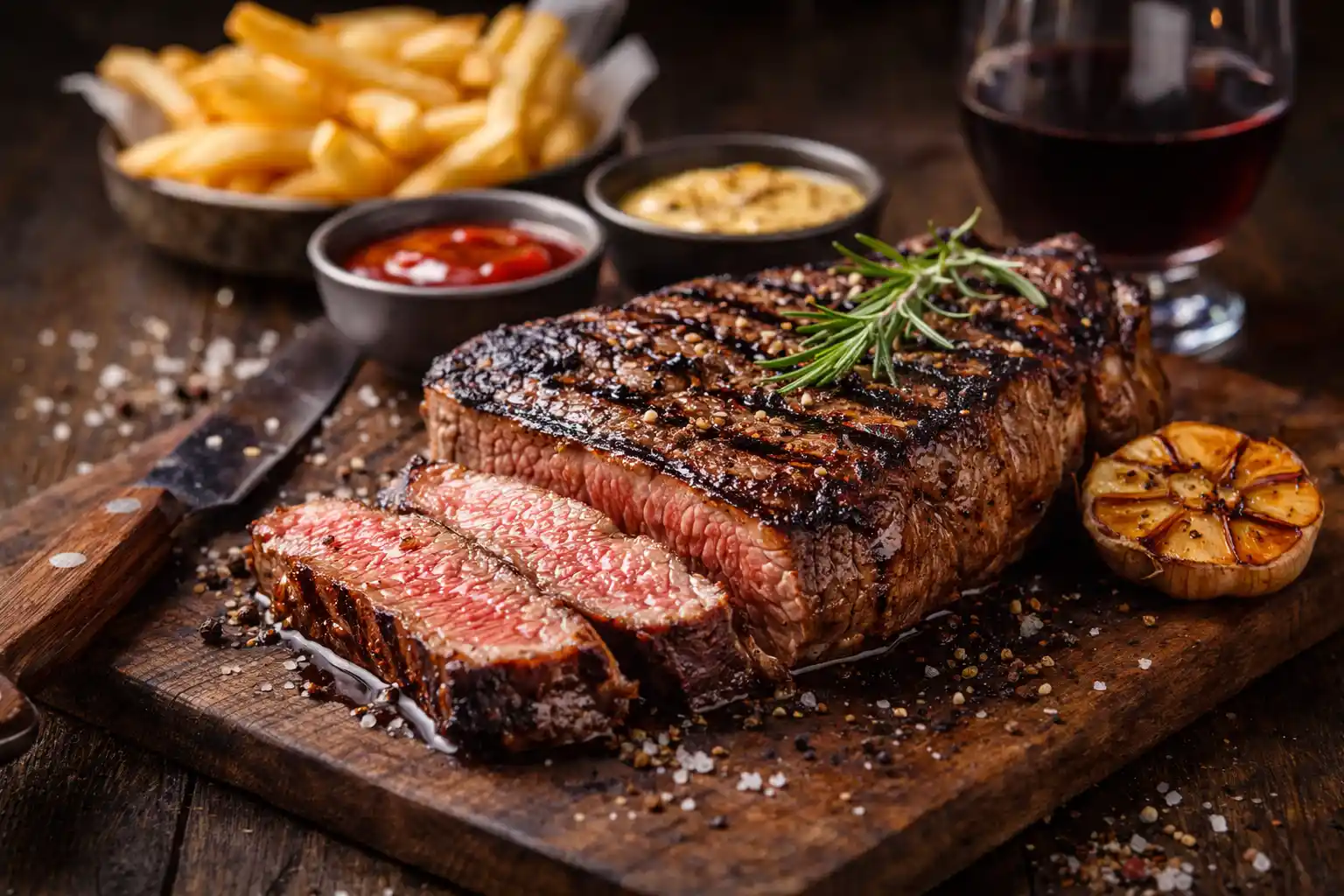
Few dishes possess the ability to stir your appetite by merely hearing the sound of meat touching a scorching iron surface — that enticing sizzle from which aromatic steam rises, carrying the promise of a golden, charred crust on the outside and tender, pink meat that melts on your tongue on the inside. This is exactly what American beef steak represents — not merely a cooked piece of meat, but a complete sensory experience that begins from the moment you select the right cut and does not end until the last bite dipped in its golden juices pooled on the plate.
In the culinary world, American steak occupies a position that no other dish contests — for it combines the simplicity of ingredients with the complexity of techniques, the attractive primitiveness of meat grilled over open flame with the sophistication of precise science behind temperatures and flavor reactions. It is a dish before which beginner and professional alike share the desire to master it, because the difference between an ordinary steak and an exceptional one may lie in details that seem simple yet make a radical difference: an extra minute on the heat, a sprinkle of salt at the right moment, or five minutes of resting before slicing.
According to Atayeb, American beef steak is considered a complete cooking experience that combines meat quality, different doneness levels, and professional grilling techniques to achieve a rich taste and luxurious flavor on your table. The truth is that this description is accurate to the utmost degree — for the perfect steak is not the result of a single factor but rather the culmination of a series of sound decisions that begin at the butcher shop and end on the serving plate.
Barbecue culture in America is not merely a cooking method — it is a lifestyle and a social ritual deeply rooted in the American collective consciousness. From family barbecue gatherings in the backyard on Sundays to upscale steakhouse restaurants in New York, Chicago, and Texas, steak represents a symbol of generosity, celebration, and quality. What distinguishes the American tradition from others is the obsession with the quality of the meat itself — the strict grading system established by the United States Department of Agriculture (USDA), the attention to cattle breeds, their feed, and the method of aging the meat — all of this makes the American steak experience one that is not easily replicated in other kitchens.
History of the Steak: From the Ranches of the American West to the World’s Tables
The story of American steak is inseparable from the story of America itself — of cowboys on the Great Plains and the vast ranches of Texas and the herds of cattle that were driven across hundreds of miles to the markets of Chicago and Kansas City in the nineteenth century. With the flourishing of the cattle-raising industry in the American West after the Civil War, and the development of railroad networks and industrial refrigeration in the 1870s and 1880s, it became possible to transport fresh, high-quality meats from farms to major cities — and here the culture of American steakhouse restaurants was born.
The city of Chicago specifically played a pivotal role thanks to its position as a center for the cattle trade and its massive slaughterhouses that processed millions of heads annually. From Chicago, steak culture spread to New York where the first upscale steakhouse restaurants opened, such as “Delmonico’s,” which is considered the first fine dining restaurant in America and the first to serve the famous “Delmonico Steak” cut in the mid-nineteenth century. From here, steak began to transform from simple cowboy food to an elegant dish that the finest restaurants took pride in.
The types of meats used evolved over the decades thanks to genetic improvement of cattle breeds. Breeds like the famous American “Angus,” “Hereford,” and “Wagyu” imported from Japan became standards of high quality thanks to the distribution of marbling fat within the meat tissue — which is the most important factor in determining a steak’s tenderness and flavor. The USDA grading system classifies meats into grades, the highest being “Prime,” which features the highest marbling ratio and constitutes only 2–3% of total meat production, followed by “Choice,” then “Select.”
The spread of steakhouses outside America came with globalization and the spread of American culture through cinema, television, and travel. Today you find steakhouse restaurants in every major city from London to Dubai to Tokyo to Buenos Aires — each adding its local touch while retaining the American fundamentals: an excellent cut of meat, high heat, simple seasoning, and a presentation that respects the ingredient.
Cooking methods have diversified as well — from traditional grilling over open charcoal that imparts a unique smoky flavor, to searing in a cast-iron skillet at very high heat to achieve a perfect Maillard crust, to the modern Reverse Sear technique that begins with slow cooking in the oven then finishes with a quick sear, all the way to the Sous Vide technique that guarantees absolute precision in doneness level. But at the core of all these methods, the fundamental principle remains the same: respect the meat, and do not hide its flavor beneath layers of excessive marinades. Classic American steak seasonings are intentionally simple — coarse salt and freshly ground black pepper are all an excellent cut of meat needs — with optional additions of garlic, butter, and sprigs of rosemary and thyme used during the basting stage to add aromatic depth.
The role of American seasonings in enhancing flavor and preserving the meat’s natural juices lies in understanding the chemistry behind them. Salt penetrates the meat fibers and breaks down some proteins, making the meat more tender and capable of retaining moisture — but timing matters: salting at least 40 minutes before cooking or immediately before cooking are the two best options, while salting 5–20 minutes before draws moisture to the surface without giving it enough time to be reabsorbed. Black pepper adds subtle heat and aromatic compounds that complement the flavor of grilled meat. And the melted butter with garlic and herbs poured over the steak in the final minutes of cooking forms a rich layer of flavor that coats every bite.
Comprehensive Recipe Card
| Dish Feature | Details |
|---|---|
| Preparation Time | 10 – 15 minutes (+ 30 minutes bringing the meat to room temperature) |
| Cooking Time | 8 – 16 minutes (depending on the thickness of the cut and the desired doneness level) |
| Resting Time Before Serving | 5 – 10 minutes |
| Total Time | Approximately one hour from start to serving |
| Servings | 2 – 4 people |
| Category | Main dishes / Meats / American cuisine |
| Difficulty Level | Intermediate – Advanced |
| Cooking Method | Charcoal grilling / Cast-iron skillet / Oven |
Steak Cut Types and Their Characteristics
Choosing the right cut is the first and most important step in the journey of preparing the perfect steak. Each cut comes from a different region of the cow’s body and has an entirely different personality in terms of tenderness, flavor, and fat content — and knowing these differences enables you to choose what suits your taste and the cooking method you intend to use.
| Cut Type | Description | Characteristics |
|---|---|---|
| Ribeye | A cut from the rib area, rich in interspersed marbling fat | Strong, rich flavor and abundant juiciness — the favorite among lovers of intense, fatty flavor |
| Sirloin | From the upper rear section, leaner and firmer | Excellent for quick grilling at high heat — a good balance between flavor and price |
| Filet Mignon | From the inner tenderloin muscle, the least used muscle of the cow | Extremely tender like butter and low in fat — ideal for those who prefer silky texture over fatty flavor |
| T-Bone | A wide cut containing a T-shaped bone separating two sections | Combines the ribeye and filet in one cut — variety in texture and flavor in every bite |
| New York Strip | From the short loin area behind the ribs, with a visible fat strip on one side | Perfectly balanced between tenderness and flavor — the favorite in classic steakhouse restaurants |
Each of these cuts responds differently to different cooking techniques. The ribeye with its abundant fat shines on the grill where the fats render and its edges char. The tender, delicately flavored filet needs a very hot cast-iron skillet and basting with herbed butter in the final moments to add the flavor it lacks. The New York Strip is versatile and works excellently with any cooking method. And the T-Bone with its large size may need a combination of techniques — searing at high heat then finishing in the oven — to ensure even doneness between the two sections that differ in thickness.
Steak Doneness Levels: The Science Behind the Color and Texture
Understanding doneness levels is what separates someone who cooks steak from someone who masters steak. Each level gives an entirely different experience in terms of texture, flavor, and juiciness, and choosing the ideal level is a matter of personal taste with no right or wrong — but knowing what each level means helps you order or cook exactly what you want.
| Level | Internal Temperature | Description |
|---|---|---|
| Rare | 49 – 52°C | A bright red, relatively cool center, very tender like jelly, abundant juiciness — for true meat enthusiasts |
| Medium Rare | 54 – 57°C | A warm red center with pink edges and a golden outer crust — the preferred level among most chefs and experts worldwide |
| Medium | 60 – 63°C | A uniform pink center with no red color, a firmer texture with good juiciness — an excellent balance for beginners |
| Medium Well | 65 – 68°C | Very faint pink in the center that is barely visible, firm meat with less juiciness |
| Well Done | 71°C and above | A completely uniform brown color with no pink whatsoever, a firmer and drier texture — the least juicy but preferred by those who do not like any pink color |
The most popular level among professional chefs and critics is without a doubt Medium Rare, because it achieves the perfect balance between meat tenderness and retaining the maximum amount of juiciness and flavor — at this level, the marbling fats begin to melt within the meat fibers without the fibers losing their moisture entirely. But do not let anyone impose a specific level on you — the perfect steak is the one you enjoy eating.
Essential Ingredients
| Ingredient | Quantity | Role / Notes |
|---|---|---|
| High-quality beef cuts (Ribeye or New York Strip) | 2 pieces, 2.5 – 3 cm thick (each piece weighing 250 – 350 grams) | The main ingredient — choose “Choice” or “Prime” grade for the best marbling |
| Coarse sea salt | 1 teaspoon per piece (or to taste) | Enhancing the natural flavor of the meat and breaking down proteins for increased tenderness |
| Freshly ground black pepper | Half a teaspoon per piece | Highlighting the taste and adding subtle aromatic heat |
| High smoke-point vegetable oil (avocado or sunflower) | 2 tablespoons | For searing — its high smoke point allows reaching sufficient heat without burning |
| Unsalted butter | 3 tablespoons | For the basting stage in the final minutes — unmatched richness and creaminess |
| Fresh rosemary sprigs | 3 – 4 sprigs | A piney aromatic flavor that infuses the melted butter and transfers to the meat |
| Fresh thyme sprigs | 3 – 4 sprigs | A warm aroma that complements the rosemary and adds herbal depth |
| Fresh garlic | 3 – 4 cloves crushed with the back of a knife (not minced) | A roasted garlic flavor that melts into the butter — light crushing releases the aromatic oils without burning |
Detailed Preparation Steps
Stage One: Preparing the Meat — Patience Before the Fire
Remove the steak cuts from the refrigerator 30 – 45 minutes before cooking and leave them on the kitchen counter covered with a paper towel to reach room temperature. This step is crucial and non-negotiable — a piece of meat that is cold at its center will cook unevenly: the surface will burn before the center reaches the desired doneness level. When the meat is at room temperature throughout, the heat spreads evenly from the surface to the center, giving you uniform doneness and a perfect crust without overcooking the outer layers.
After the meat reaches room temperature, dry its surface completely with paper towels — both sides and the edges. You may need to replace the towel twice to absorb all the moisture. This drying is the secret to the golden, charred crust (the crust). Surface moisture wets the meat and turns it from “grilling” to “boiling” — because water evaporates at 100°C and prevents the surface from reaching 140°C where the magical Maillard reaction begins, producing hundreds of aromatic compounds responsible for that irresistible grilled flavor.
Stage Two: Seasoning the Steak — Less Is More
The philosophy of classic American seasoning is based on one principle: do not hide the flavor of the meat. Generously sprinkle coarse sea salt and freshly ground black pepper on both sides and on the edges. Use your hands to distribute the spices evenly and press them gently onto the surface so they adhere.
The ideal timing for salting is one of the most debated topics in the world of steak. There are two schools of thought: the first salts the meat 40 – 60 minutes before cooking (called dry brining) where the salt draws moisture out first, then the meat reabsorbs it along with the salt, becoming more flavorful and tender from the inside. The second salts immediately before placing the meat on the heat. Both methods are successful — what must be avoided is salting only 5 – 20 minutes before, because the salt will have drawn moisture to the surface without giving it enough time to be reabsorbed, resulting in a wet surface that hinders searing.
Stage Three: Grilling Techniques — Choose Your Weapon
Grilling over charcoal is the most authentic method and the closest to the roots of American steak. It imparts a distinctive smoky flavor that cannot be replicated by any other method — the fats that drip from the meat onto the embers vaporize and rise as aromatic smoke that envelops the steak in a unique layer of flavor. Set up two zones on the grill: a direct high-heat zone (for quick searing) and an indirect heat zone (for gently finishing the cook). Sear the steak for 2 – 3 minutes per side over the direct heat, then move it to the indirect zone until it reaches the desired internal temperature.
The cast-iron skillet is the favorite among restaurant chefs because it provides the highest degree of contact between the meat’s surface and the cooking surface — which means an unmatched Maillard crust. Heat the skillet over high heat until it begins to lightly smoke (this is essential — a skillet that is not hot enough will not produce a crust). Add the high smoke-point oil, then carefully place the steak and leave it without moving for 3 – 4 minutes until a dark golden crust forms. Flip it only once and repeat on the other side. In the last two minutes, add the butter, crushed garlic, and rosemary and thyme sprigs to the skillet — when the butter melts and begins to foam, tilt the skillet and spoon the melted aromatic butter over the surface of the steak repeatedly (the basting technique). This moment is true magic — the butter carries the flavors of garlic and herbs and coats the meat in a gleaming golden layer.
The oven (Reverse Sear method) is the best option for very thick cuts (more than 4 cm). Preheat the oven to 120°C, place the steak on a wire rack over a baking sheet, and cook it slowly until its internal temperature reaches 5 – 7 degrees below the desired final temperature. Then remove it and sear it in an extremely hot cast-iron skillet for one minute per side. This method yields the most uniform doneness possible — a consistent pink color from edge to edge with a thin, crispy crust.
Stage Four: Cooking by Doneness Level — Precision Is Everything
An internal meat thermometer is the most important tool in your kitchen if you are serious about steak. Insert the probe into the thickest point of the meat from the side (not from the top) and make sure it is in the center of the cut, not near the surface or the bone. Pull the steak from the heat when the internal temperature reaches 3 – 5 degrees below the desired final temperature — because carryover cooking will continue to raise the internal temperature during the resting period.
The golden rule that every professional chef repeats: flip the steak only once. Every additional flip interrupts the crust formation, extends the cooking time, and causes the meat to lose its juices. Place it on the heat, wait patiently for the crust to form, flip it once, and wait. Do not press the meat with a spoon or fork — this squeezes the juices out and dries it. And do not cut it to check the internal color — use the thermometer instead.
Stage Five: Resting and Serving — The Final Patience That Is Rewarded
Lift the steak from the skillet or grill and place it on a wooden cutting board or a warm plate. Cover it loosely with aluminum foil (without sealing tightly) and let it rest for 5 – 10 minutes. These minutes are not a luxury — they are the difference between a steak that spills its juices onto the plate when you cut it (a waste!) and a steak that retains its juices within every bite. During cooking, the heat pushes the juices toward the center of the meat. The resting period allows the juices to redistribute evenly throughout all the fibers, so when you cut the meat, the juices stay in place instead of flowing out.
Serve the steak on a warm plate (heat the plates in the oven at low temperature for a few minutes) so the meat does not cool quickly. You can slice it into wide strips at an angle against the grain for maximum tenderness, or serve it as a whole piece for each person to cut themselves.
Accompany the steak with whatever you like — grilled vegetables (asparagus, mushrooms, zucchini), baked or fried potatoes, a refreshing green salad, or traditional American sauces such as creamy peppercorn sauce, mushroom cream sauce, or Argentinian chimichurri sauce for those who enjoy a tangy herbal touch.
A tip from Atayeb: you can add a touch of compound butter on the steak just before serving to impart a rich and luxurious flavor. Prepare it in advance by mixing softened butter with chopped parsley, crushed garlic, lemon zest, and a pinch of salt, then wrap it in plastic wrap in a cylindrical shape and chill it in the refrigerator. A single slice melts on the surface of the hot steak and creates an instant sauce that requires no additional effort.
Secrets of Success and Scientific Tips
Choosing high-quality meat is 80% of the battle. Look for cuts with visible marbling — those thin white lines of fat interspersed within the red meat tissue. These fats melt during cooking and become internal juices that give the meat its tenderness and flavor. Meat without marbling will be dry no matter how well you master cooking techniques. If you can obtain dry-aged meat for 21 – 45 days, you will get an indescribable depth of flavor and concentration — dry aging evaporates moisture from the meat, concentrates its flavor, and enzymes break down some fibers making it more tender.
Drying the meat before cooking is not a suggestion — it is a fundamental requirement. The Maillard reaction that produces the complex-flavored golden crust only occurs on a dry surface at temperatures above 140°C. Any surface moisture means that heat energy will be wasted evaporating water before browning begins. Some professional chefs go even further — they leave the steak uncovered on a rack in the refrigerator overnight so its surface dries completely, which yields an exceptional crust.
Controlling heat during grilling is the art of balancing crust and juiciness. Very high heat gives a wonderful crust but may burn the surface before the inside is done. Very low heat will not produce a crust at all. The solution is to start with very high heat for quick searing (90 seconds – 3 minutes per side) then lower the heat or move the meat to a cooler zone to finish cooking gently. This principle applies to all techniques — charcoal, skillet, and oven.
The resting period after cooking is not an optional step — it is the difference between an excellent steak and an exceptional steak. The practical rule: one minute of rest for every 100 grams of the cut’s weight, or approximately half the cooking time. During this period, the internal temperature rises an additional 3 – 5 degrees (which is why you pull the meat before the desired temperature), and the muscle fibers relax and reabsorb the juices that accumulated in the center.
Frequently Asked Questions About the Recipe
Can frozen meat be used directly?
Yes, you can, but it must be fully thawed in the refrigerator (not on the kitchen counter) and its surface must be thoroughly dried before cooking. Frozen meat loses some of its moisture during thawing due to ice crystals breaking some cells — so thorough drying is even more important here. Some chefs actually prefer cooking the steak directly from its frozen state (frozen-to-pan) at high heat then finishing the cook in a low oven — a technique that has proven effective in some experiments but requires practice.
Can the steak be seasoned hours in advance?
Yes, and this is called “dry brine.” You can season the steak with salt 2 – 4 hours or even the night before and leave it uncovered on a rack in the refrigerator. This yields a deeper flavor, greater tenderness, and a drier surface (ideal for crispiness). But avoid adding black pepper early — it can become bitter if exposed to high heat for a long time. Add the pepper immediately before cooking.
What is the best tip for grilling over charcoal?
Use medium to high heat with the grill grate positioned 10 – 15 cm from the embers. Set up two zones: direct and indirect. Make sure the grate is clean and oiled to prevent sticking. The most common mistake is using charcoal that is still burning with flames — wait until the charcoal turns into white glowing embers with no flames for stable heat and a clean smoky flavor without a sooty taste.
What is the difference between butter and oil in cooking steak?
Oil is used at the beginning for searing because its smoke point is higher (butter burns at 175°C while avocado oil can withstand up to 270°C). Butter is added only at the end — when the heat subsides — to add richness and flavor and for the basting technique. Combining the two gives you the best of both worlds: a perfect crust and a luxurious flavor.
Approximate Nutritional Value
| Nutrient | Value per Serving (one ribeye steak ≈ 250 grams cooked) | Additional Notes |
|---|---|---|
| Calories | 500 – 650 calories | Depends on the type of cut, fat ratio, and amount of butter used |
| Protein | 45 – 55 grams | Complete, high-quality animal protein containing all essential amino acids |
| Fat | 30 – 45 grams | A mix of saturated and monounsaturated fats — lower in filet and higher in ribeye |
| Iron | 4 – 6 mg (20 – 35% of daily requirement) | Heme iron that is easily absorbed — red meat is one of the richest sources |
| Zinc | 8 – 12 mg (70 – 110% of daily requirement) | Essential for immunity and wound healing |
| Vitamin B12 | 5 – 8 micrograms (200%+ of daily requirement) | Vital for nerve health and blood formation |
Beef is considered one of the richest dietary sources of high-quality protein and heme iron, which the body absorbs with efficiency several times greater than plant-based iron. It is also an exceptional source of zinc, vitamin B12, selenium, niacin, and vitamin B6. The grilling or searing method instead of deep frying preserves the nutritional value and keeps the calories within reasonable limits. For a leaner option, choose the filet or sirloin cut instead of the ribeye, and use less butter.
Conclusion: More Than Just a Piece of Meat
American beef steak is not merely a dish — it is an art form in its own right that combines the science of selecting meat and knowing its cuts, understanding the chemistry behind searing, salting, and temperatures, the skill of controlling fire and timing, and the patience of waiting during the resting period before that rewarding moment when the knife touches the surface of the crispy crust and reveals that gleaming pink center saturated with juices. It is a dish that rewards you for every minute you invest in learning and mastering it — because the difference between a good steak and a great steak is not in expensive ingredients but in the small details that are now in your hands.
Whether you are planning a romantic dinner for two, a family barbecue on the weekend, or simply want to treat yourself after a long week — American steak is that dish that transforms any occasion into a celebration. Prepare your grill or your cast-iron skillet, choose your favorite cut, and follow the steps we have outlined — and you will discover that preparing a restaurant-quality steak in your kitchen is not a distant dream but a skill that anyone can acquire.
Try preparing American beef steak following the steps from Atayeb to enjoy a complete cooking experience, rich juiciness, and a perfect doneness level on your table. Bon appétit! 🥩🔥