Introduction: The Dish That Conquered the World from Southern American Kitchens
There are sounds in the culinary world that no one can mistake — and the sound of a seasoned piece of chicken sliding into hot, bubbling oil producing that enticing sizzle is undoubtedly one of the most appetite-stirring sounds on earth. When that aromatic steam rises, laden with the scent of spices, garlic, and smoked paprika, and the outer coating begins to transform from soft and white to golden and crispy — you know you are witnessing a dish that possesses a unique ability to gather people around a single table and delight them with every bite.
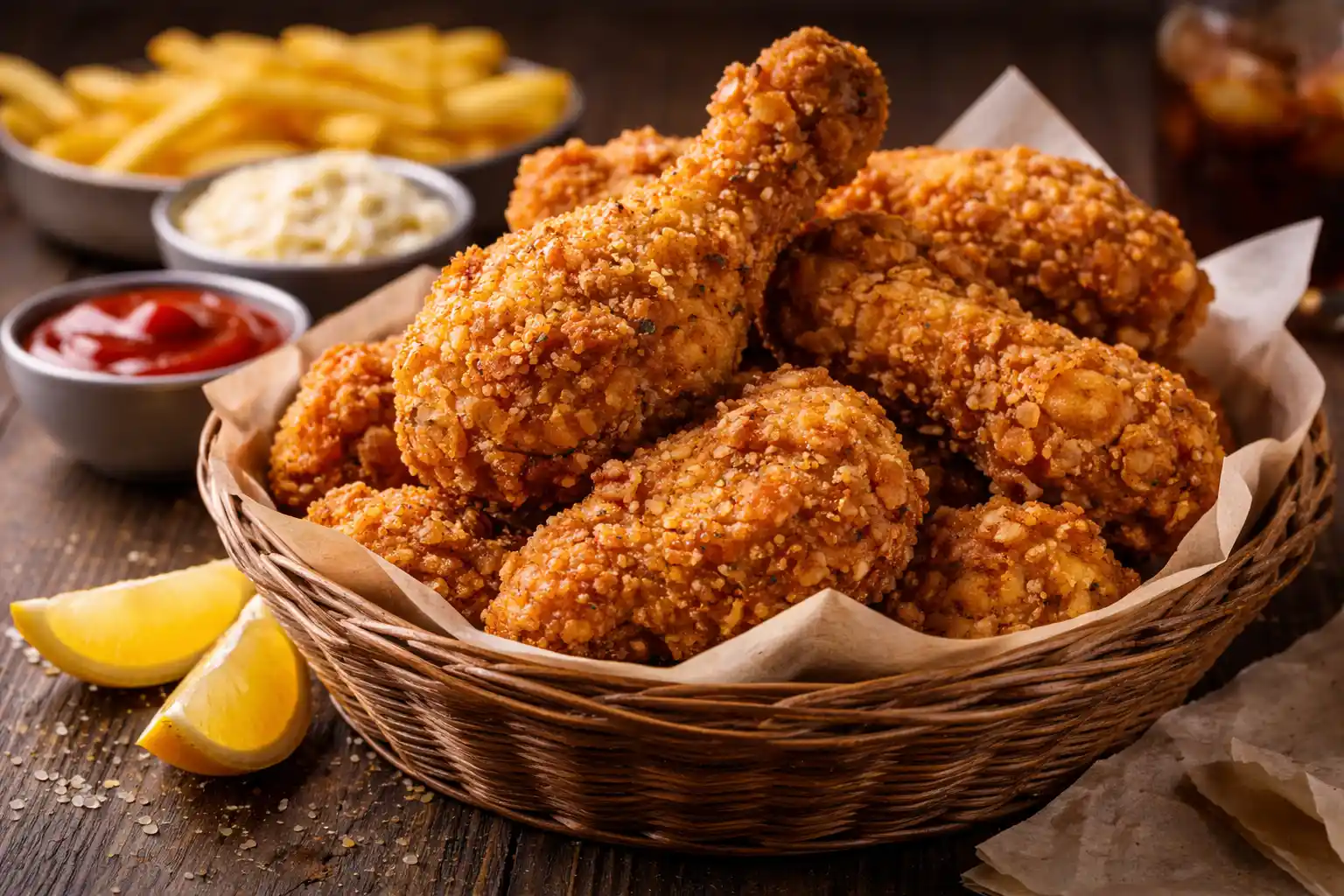
American fried chicken is not merely a meal — it is a cultural institution in its own right. From the humble kitchens of the American South in Alabama, Georgia, Louisiana, and Tennessee, this dish launched itself to become one of the world’s most popular and beloved dishes. On every continent and in every city, you will find a version of fried chicken carrying a local touch — but the original remains that Southern American chicken with its thick, golden, crispy crust on the outside and its tender, juicy white meat on the inside, infused with a seasoning whose roots stretch back more than two centuries.
What makes this dish exceptional is not its complexity — but its calculated simplicity. Ingredients available in every kitchen, clear techniques that anyone can learn, yet the difference lies in the details: the duration of soaking in the acidic marinade, the ratio of flour to cornstarch, the exact temperature of the oil, and that patience in not moving the pieces during frying. These details are what separate ordinary fried chicken from fried chicken that makes your fingers refuse to stop.
According to Atayeb, American fried chicken is considered a traditional Southern dish that combines a rich aromatic seasoning with the perfect crunch, delivering a unique and beloved cooking experience on the American and global table. This description captures the truth precisely — for the secret behind this dish’s success across decades lies in a golden trio: a seasoning that penetrates the meat down to the bone, a crust that resists your teeth with that satisfying crunch then surrenders to reveal meat that melts with its tenderness, and a complex spice flavor that combines heat, warmth, and aroma in every bite.
History of the Dish: A Journey from Southern Farms to the World’s Tables
The story of American fried chicken is a story of cultures converging and cooking traditions blending on new land. The true roots of this dish trace back to the eighteenth and nineteenth centuries in the American Southern states, where the deep-frying techniques brought by Scottish and English settlers from Europe met the arts of seasoning and spicing mastered by African Americans, who added an entirely new dimension of flavor and complexity that did not exist in the simple European versions.
The Scottish settlers used to fry chicken in animal fat with barely any seasoning — just salt and a light coating of flour. But it was the African American cooks in Southern kitchens who brought about the real revolution: they added complex spice blends, soaking in acidic liquids to tenderize the meat, and double-coating in seasoned flour to achieve that distinctive thick crust. This transformation from a simple dish to a masterpiece of flavor is what gave Southern fried chicken its unique identity that remains alive to this day — and it is an important historical acknowledgment of the African American contribution that changed the face of American cuisine entirely.
In the nineteenth century and the early twentieth century, fried chicken became a central dish in Southern American culture — it was associated with family feasts after Sunday services, summer outdoor barbecues, and holiday and occasion gatherings. It was a thoroughly democratic dish that united all social classes in their love for it — from the simple tables of farmers to elegant state banquets. This deep emotional connection to family memory and happy occasions is what gave fried chicken its special standing that transcends being merely food to being part of cultural identity.
The great global leap came in the second half of the twentieth century with the rise of the fast food industry. When Harland Sanders (Colonel Sanders) opened the first Kentucky Fried Chicken (KFC) restaurant in the 1950s with his secret recipe of 11 herbs and spices, fried chicken launched from the borders of the American South to every corner of the world. But its spread through fast food restaurants did not eliminate the original homemade version — rather, it ignited global curiosity toward it. Today you find upscale restaurants in New York, London, Tokyo, Seoul, and Dubai serving meticulously crafted versions of Southern fried chicken at premium prices — proof that this dish, humble in its origins, is capable of occupying a prestigious position in the world of haute cuisine.
Preparation methods evolved notably over the decades. From the traditional frying in a cast-iron skillet filled with lard (the original Southern method) to deep frying in clean vegetable oil, then came the healthier oven-baked versions that achieve an acceptable crunch with far less oil, and finally the modern air fryer technique that has become a favorite for many. All these methods have their place, but traditional deep frying in hot oil remains the method that delivers that classic crunch unmatched by any other — because the hot oil surrounds every centimeter of the piece and provides even browning and uniform crispiness from all sides.
As for the original Southern seasoning, it has maintained its essence despite evolution: its base is the acidic liquid (buttermilk) that tenderizes the meat fibers and carries the spices deep into the chicken, and the spice blend that includes smoked paprika, cayenne pepper, garlic, dried onion, oregano, and sometimes ground mustard and cumin. This blend is what gives Southern fried chicken its distinctive complexity that makes you pause at every bite trying to distinguish the different layers of flavor.
Comprehensive Recipe Card
| Dish Feature | Details |
|---|---|
| Preparation Time | 20 minutes |
| Marinating Time | One hour minimum (preferably 8 – 12 hours / overnight) |
| Frying Time | 25 – 35 minutes (in batches) |
| Total Time | Approximately two hours (with short marinating) or start preparation the night before |
| Servings | 4 – 6 people |
| Category | Main dishes / Fried chicken / Southern American cuisine |
| Difficulty Level | Intermediate |
| Cooking Method | Deep frying (or oven baking as a healthier alternative) |
Ingredients and Measurements
Liquid Marinade Ingredients (Soaking)
| Ingredient | Quantity | Role / Notes |
|---|---|---|
| Whole chicken cut into 8 – 10 pieces (or thighs and drumsticks only) | 1.5 – 2 kg | The main ingredient — choose fresh chicken with thick meat for the best juiciness |
| Liquid yogurt or buttermilk | 2 cups (500 ml) | The magical ingredient — the acidity breaks down protein fibers, tenderizes the meat, and helps the crust adhere |
| Fresh garlic, crushed | 4 – 5 cloves | A deep aromatic flavor that penetrates the meat during soaking |
| Ground red hot pepper (cayenne) | 1 teaspoon | To add a subtle, sneaking heat that balances the richness of the fat |
| Smoked paprika | 1 tablespoon | To enhance the golden-red color and add a warm smoky flavor |
| Sea salt | 1 tablespoon | Balances the flavor and penetrates the meat |
| Freshly ground black pepper | 1 teaspoon | A smooth aromatic heat |
| Dried ground onion | 1 teaspoon | Depth of flavor without the moisture of fresh onion |
| Hot sauce (Tabasco or whatever is available) — optional | 1 tablespoon | An additional layer of heat and subtle acidity |
Crispy Crust Mixture Ingredients (Dry Coating)
| Ingredient | Quantity | Role / Notes |
|---|---|---|
| All-purpose flour | 2 cups (250 grams) | The base that forms the crispy crust |
| Cornstarch | Half a cup (65 grams) | The secret weapon for extra crunch — it absorbs less moisture than flour so it stays crispier |
| Smoked paprika | 1 tablespoon | To unify the flavor between the crust and the inner seasoning |
| Dried ground garlic | 1 teaspoon | Enhancing the garlic layer |
| Dried ground onion | 1 teaspoon | Flavor integration |
| Red hot pepper (cayenne) | Half a teaspoon | Subtle heat in the crust |
| Salt | 1 teaspoon | Don’t forget to season the crust — many people season only the meat and forget the flour |
| Black pepper | Half a teaspoon | Integration |
| Baking powder (optional) | Half a teaspoon | Produces small bubbles during frying that double the crunch and lightness |
For Frying
| Ingredient | Quantity | Notes |
|---|---|---|
| Vegetable oil for deep frying (soybean oil, canola, sunflower, or peanut oil) | 1.5 – 2 liters | Enough to fully submerge the pieces — peanut oil is the traditional Southern favorite for its high smoke point and neutral flavor |
Detailed Preparation Steps
Stage One: Preparing the Chicken — The Proper Foundation
Start by thoroughly cleaning the chicken pieces under cold running water, then pat them dry with paper towels. If you are using a whole chicken, cut it into 8 – 10 pieces: two breasts split in half, two thighs, two drumsticks, and two wings. Equally sized pieces ensure even cooking during frying — a thick breast piece needs more time than a thin wing, so separating the different sizes allows you to remove each piece when it is perfectly done.
Leave the chicken on the kitchen counter for 15 – 20 minutes to approach room temperature. Very cold chicken significantly lowers the oil temperature when submerged, which slows crust formation and leads to greater oil absorption — the result: oily, heavy chicken instead of crispy and light.
Stage Two: The Southern Seasoning — Where Flavor Is Born
In a large bowl or a tightly sealed plastic bag, mix the liquid yogurt (buttermilk) with the crushed garlic, red pepper, smoked paprika, salt, black pepper, dried onion, and hot sauce. Stir the mixture until the spices dissolve and unify completely.
Submerge the chicken pieces in this mixture and ensure that every piece is fully covered. Cover the bowl or seal the bag and place it in the refrigerator. The minimum soaking time is one hour — but the real magic happens when you leave the chicken overnight (8 – 12 hours). During this time, a wonderful chemical reaction occurs: the acidity in the buttermilk breaks down collagen proteins in the meat fibers, making it more tender, while the salt and spices penetrate deep into the meat all the way to the bone — the result is chicken seasoned from the inside out, not just on the surface. This is the fundamental difference between professional homemade fried chicken and rushed versions that settle for surface-level seasoning.
Buttermilk specifically is the secret ingredient in the Southern marinade for several reasons beyond tenderizing: the proteins in it crack during frying and form an additional layer of crunch, the natural sugars contribute to the Maillard reaction that gives the crust its distinctive deep golden color, and the slightly viscous texture helps the flour adhere better to the chicken’s surface. If you cannot find buttermilk, you can make it at home by adding a tablespoon of lemon juice or white vinegar to a cup of whole milk and leaving it for 10 minutes until it slightly curdles.
Stage Three: Preparing the Crispy Crust Mixture — Engineering the Crunch
In a wide, deep bowl, mix the flour with the cornstarch, paprika, dried garlic, dried onion, red pepper, salt, black pepper, and baking powder. Stir with a fork or whisk until the spices are evenly distributed throughout the flour — you do not want areas concentrated with spices and others devoid of them.
Now comes the most important step in building the crust: remove each chicken piece from the buttermilk marinade and let the excess drip off slightly (but do not wipe it — you want a moist layer on the surface). Place the piece in the flour mixture and press the flour onto every surface, every fold, and every corner. Lift the piece and gently shake off the excess flour.
Here comes the double-crunch secret that professionals use: before coating the chicken, add 2 – 3 tablespoons of the used buttermilk marinade to the flour mixture and rub it in with your fingertips. Small clumps and irregular flakes will form in the flour — these clumps are what produce those bumps and ridges of crunch that you see in the best fried chicken restaurants. When fried, these flakes transform into a multi-layered crust of crunch instead of a smooth, flat coating.
Place the coated pieces on a wire rack over a baking sheet and let them rest for 15 – 20 minutes before frying. This resting allows the moisture from the chicken’s surface to hydrate the inner flour layer so it adheres permanently — without this step, the crust may separate from the meat during frying and float in the oil in a frustrating manner.
Stage Four: Deep Frying — The Art of Heat Control
Pour the oil into a deep, heavy-bottomed pot (a cast-iron pot is best because it retains heat steadily) or a deep skillet. The depth of the oil should be sufficient to fully submerge the pieces or at least two-thirds of their height. Heat the oil over medium heat until it reaches 170 – 180 degrees Celsius. An oil thermometer (or cooking thermometer) is essential here — relying on guesswork for oil temperature is the most common cause of fried chicken failure.
Why this specific temperature? If the oil is cooler than 160°C, the chicken will absorb a large amount of oil before the crust forms — the result is heavy, greasy, oil-saturated chicken. If it is hotter than 190°C, the crust will burn and turn dark brown quickly while the meat remains raw on the inside. At approximately 175°C, the perfect balance occurs: the crust forms quickly enough to seal the meat and prevent oil from entering, while the heat gently penetrates inward to cook the meat evenly.
Lower the pieces into the oil gently and carefully, one at a time, using long tongs. The golden rule: do not overcrowd the pan. Fry 3 – 4 pieces at a time maximum. Overcrowding causes a sharp drop in oil temperature and prevents the free circulation of oil around each piece — resulting in uneven cooking and weak crispiness.
Let the pieces fry without moving them for 6 – 8 minutes on the first side until a stable golden crust forms, then gently flip them and leave them for another 6 – 8 minutes on the second side. Large pieces (thighs and breasts) need 12 – 15 minutes total, while wings and smaller pieces need 8 – 10 minutes. The foolproof way to confirm doneness is to measure the internal temperature with a meat thermometer — it should reach 74°C (165°F) at the thickest point of the meat near the bone.
When you remove each batch, place the pieces on a wire rack over a baking sheet (not directly on paper towels — the rack allows oil to drain from all sides and prevents the bottom crust from getting soggy from condensed steam). Let the oil return to the required temperature before lowering the next batch — this patience is rewarded with uniform crispiness in every piece.
Stage Five: Serving — The Awaited Moment
Serve the fried chicken hot immediately after frying and draining the oil — the crunch is at its peak during the first ten minutes after coming out of the oil. Arrange the pieces on a large serving platter or a bread basket lined with parchment paper.
The traditional side dishes that accompany Southern fried chicken are an integral part of the experience: crispy French fries or buttery mashed potatoes, refreshing coleslaw with mayonnaise and vinegar dressing that balances the richness of the chicken with its acidity and freshness, slightly sweet Southern cornbread, beans cooked in sauce, or simply slices of fresh cucumber and tomato. Favorite sauces include American hot sauce, honey mustard sauce, creamy ranch sauce, or even pure honey served for dipping — the contrast between the sweetness of honey and the chicken’s spices is an extraordinary flavor experience.
A tip from Atayeb: you can sprinkle a little freshly chopped herbs — such as parsley or dill — on top just before serving to add an aromatic and aesthetic touch that brings a vibrant green color highlighting the beauty of the crust’s golden hue.
Secrets of Success and Scientific Tips
The quality of the chicken is the starting point. Fresh chicken with thick, firm meat yields richer juiciness and better texture than frozen chicken, which loses moisture during thawing. If you can obtain free-range or organic chicken, you will notice a clear difference in flavor. Thighs and drumsticks (dark meat) are the favorite among most fried chicken enthusiasts because they are juicier and more forgiving of overcooking than chicken breasts (white meat), which dry out faster.
The length of the soaking time makes the biggest difference. One hour gives an acceptable result, but an entire night transforms the chicken to an entirely different level of tenderness and depth of flavor. The acidity in the buttermilk works slowly — the more time, the greater the penetration and gentle breakdown of meat fibers. But do not exceed 24 hours because excessive acidity may break down the fibers too much, making the texture closer to paste.
Maintaining a steady oil temperature is the most important secret during frying. Invest in an oil thermometer — its price is modest but its impact is enormous. Monitor the temperature constantly and adjust the flame as needed. Every batch of chicken you lower into the oil will temporarily reduce the temperature — and this is normal — but a heavy pot helps recover the heat quickly.
Frying in small batches is not a luxury — it is a necessity. The temptation is great to lower all the pieces at once to save time, but the result will be moist, oil-saturated chicken with a pale crust. Three to four pieces at a time is the rule — even if it takes longer, the crunch is worth the wait.
Frequently Asked Questions About the Recipe
Can the oven be used instead of frying?
Absolutely, and this is an excellent option for those who want to reduce fat. Preheat the oven to 200°C, place the flour-coated pieces on a wire rack over a baking sheet, and spray or brush their surface with a light oil mist. Bake for 35 – 45 minutes, flipping halfway through, until golden and crispy. The crunch will not be at the same level as deep frying, but it is very satisfying and much lighter. You can also combine both methods: sear the pieces in a skillet with a little oil for 3 minutes per side, then finish cooking in the oven.
Can the marinade be prepared in advance and stored?
Yes, you can prepare the buttermilk and spice mixture and store it in a sealed container in the refrigerator for up to 24 hours before adding the chicken to it. In fact, preparing it in advance allows the spices to blend and interact with each other, resulting in a more harmonious and deeper flavor.
What are the best types of flour for frying?
All-purpose flour is the classic and best choice — it provides excellent crunch and good adhesion. Adding cornstarch at approximately one-quarter of the quantity doubles the crunch because starch absorbs less moisture. Some recipes use rice flour as a substitute for starch — and it is an excellent option as well, yielding a thin, glass-like crispiness. Avoid self-rising flour unless you want a thicker, puffier crust (some Southern recipes use it intentionally for this purpose).
Approximate Nutritional Value
| Nutrient | Value per Serving (two medium pieces — approximately a thigh and drumstick) | Additional Notes |
|---|---|---|
| Calories | 450 – 550 calories | Depends on the size of the pieces, the amount of oil absorbed, and the type of piece (breast is less, thigh is more) |
| Protein | 35 – 42 grams | High-quality animal protein from the chicken |
| Fat | 22 – 30 grams | From the oil absorbed in the crust and the chicken’s natural fats — reduced in the baked version |
| Carbohydrates | 20 – 28 grams | Primarily from the crispy flour and starch coating |
| Sodium | 800 – 1200 mg | Depending on the amount of salt in the marinade and flour — can be reduced by lowering the salt |
| Iron | 2 – 3 mg | A good source especially from dark meat (thighs and drumsticks) |
Fried chicken is a dish rich in high-quality protein, iron, and B-complex vitamins, but it contains a higher proportion of fat and calories than grilled chicken due to deep frying. For a lighter version, you can use chicken breasts instead of thighs, reduce the thickness of the flour coating, or adopt the oven-baking method. In any case, enjoying fried chicken from time to time as a celebratory family meal is part of a healthy balance that combines pleasure and nutrition.
Conclusion: A Dish That Gathers Hearts Before Plates
American fried chicken is more than just a meal — it is an aromatic memory that takes you back to warm family gatherings, sunny summer trips, and simple moments that turned into unforgettable memories thanks to a dish that unites everyone in their love for it. From the humble kitchens of the American South in the nineteenth century to the tables of the entire world in the twenty-first century, this dish has proven that simple food made with care and love possesses an unlimited ability to bring happiness to people and bring them together.
There is nothing more satisfying than that moment when your teeth break through that golden, crispy crust and reach the tender, juicy white meat inside — meat infused with the flavor of Southern spices down to the bone, melting on your tongue and making you close your eyes for a second to absorb all those layers of flavor. This is the magic of real fried chicken — it does not need complexity or rare ingredients, but rather patience in seasoning, mastery in frying, and respect for those small details that are now in your hands.
Whether you are preparing a family dinner on Friday, a feast for special guests, or planning an outdoor outing with friends — fried chicken is that dish that guarantees wide smiles and empty plates. Try preparing American fried chicken following the steps from Atayeb to enjoy the perfect crunch, the original Southern seasoning, and an unforgettable flavor on your table. Bon appétit! 🍗✨