Cultural and Historical Introduction
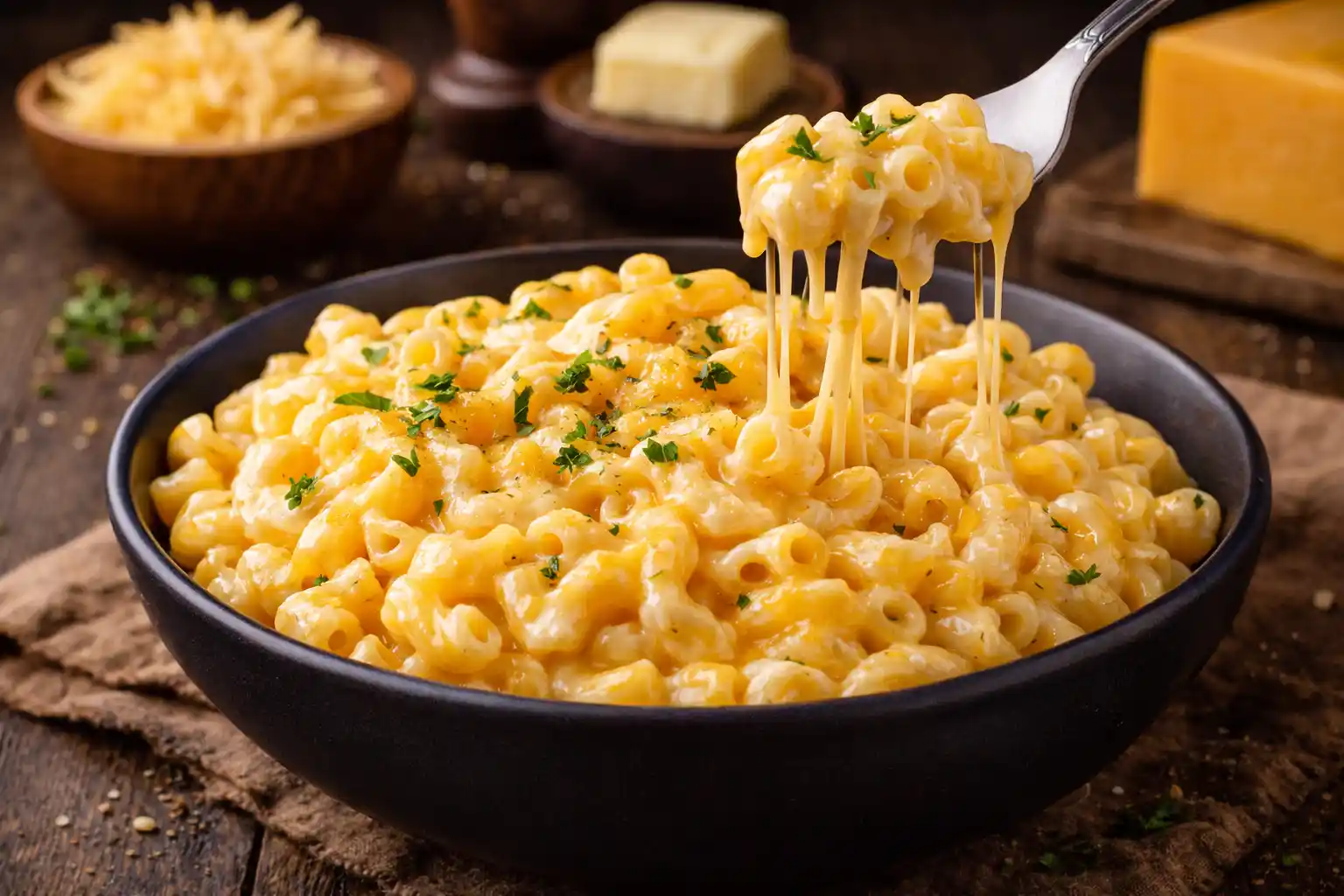
In nearly every American home, from the wooden cabins in rural Vermont to the apartments overlooking Manhattan’s skyscrapers, from the vast ranches of Texas to the streets of New Orleans pulsing with music and life, there is one dish that everyone agrees on without exception — a dish that transcends political disagreements, cultural differences, and class disparities to become a shared language spoken by millions of Americans for more than two centuries. It is Mac and Cheese — that simple, magical, astounding blend of short boiled pasta and golden, creamy cheese sauce that envelops every piece of pasta in a warm embrace of rich, satisfying flavor.
Mac and Cheese is not merely a food dish — it is an American cultural institution in every sense of the word. It is the dish that American children learn to love before they learn to read, the one served in elementary school cafeterias as a daily lunch, the one that fills family restaurant dining rooms on Sundays, and the one that occupies a permanent corner on Thanksgiving tables, summer barbecues, and family gatherings. Above all, it is the literal embodiment of the concept of “Comfort Food” — that category of dishes that does not just feed the body but nourishes the soul, the memory, and the emotions, transporting a person back to moments of warmth, security, and simplicity.
The secret to the greatness of Mac and Cheese lies in its beautiful contradiction: it is simple in its ingredients to the point that anyone can prepare it — pasta, cheese, butter, and milk — yet complex in its flavor to the point that the world’s greatest chefs still compete to present the perfect version of it. The choice of cheese types makes all the difference between an ordinary Mac and Cheese and an extraordinary one. Sharp cheddar gives the dish its strong, distinctive character, mozzarella adds that appetizing stretch that extends when lifting a spoon, Swiss Gruyère gives a complex, nutty depth of flavor, and American cheese contributes that smooth creaminess that makes the sauce silky and irresistible.
According to Atayeb, Mac and Cheese is considered a traditional American dish that combines the rich flavor of cheese with the creamy texture of pasta, making it a beloved meal across generations on American and global tables alike, and a dish that transforms every time it is prepared into a small celebration of the honest pleasure of eating.
History and Origins of the Dish
The story of Mac and Cheese is older and more complex than many expect. Despite its close association with American culture, its roots actually extend to Europe — specifically to Italy and England — before it crossed the Atlantic Ocean and found in America its true homeland that adopted it and gave it its enduring identity.
The earliest known references to a dish combining pasta with cheese date back to Italian cookbooks of the fourteenth century, where it was known by various names and prepared in the simplest of ways: boiled pasta mixed with grated cheese and butter. However, the version closest to modern Mac and Cheese appeared in England during the eighteenth century, where English chefs began preparing cooked cheese sauces using the roux technique (a mixture of butter and flour) and pouring them over boiled pasta.
The true American story of Mac and Cheese begins with one of the most prominent Founding Fathers of the United States — the third President, Thomas Jefferson. During his years of residence in France as the American ambassador in the 1780s, Jefferson tasted pasta and cheese dishes in Europe and was immensely impressed. It is said that upon his return to America, he brought with him a pasta-making machine and quantities of Italian Parmesan cheese, and then instructed his personal chef James Hemings — who had trained in French cooking in Paris — to prepare a pasta and cheese dish at a formal dinner at the White House in 1802. That dinner is considered the moment Mac and Cheese entered American history through its grandest doors.
From the White House, the dish gradually spread through American kitchens during the nineteenth century and appeared in popular cookbooks. But the greatest transformation came during the Great Depression of the 1930s and World War II. In those difficult years when millions of Americans suffered from scarce food resources, Mac and Cheese became the dish of survival — its ingredients were cheap and available (dry pasta, processed cheese, and milk), it could feed a large family at minimal cost, and it was rich in calories and protein needed by workers and soldiers. In 1937, the Kraft company launched its famous product “Kraft Macaroni & Cheese” in a blue box that became an American icon in its own right — a package containing dry pasta and a packet of cheese powder, at a price of just 19 cents, enough for four people. Four million boxes were sold in the first months alone, and it became a symbol of American inventive genius in the face of crises.
After the war, Mac and Cheese continued its rise in American culture. It entered school cafeterias as a daily staple meal and became a fixed dish in university cafeterias, hospitals, and military bases. In African American communities in the American South, Mac and Cheese evolved to become a fundamental pillar of “Soul Food” cuisine, where mothers and grandmothers mastered the art of preparing baked versions rich with several types of cheese, eggs, and cream, and its presence became mandatory at Thanksgiving feasts and Sunday gatherings after church. In the traditional American restaurants known as “Diners,” Mac and Cheese occupied a permanent spot on the menu as a side dish served alongside burgers, grilled meat, and fried chicken.
The spread of the dish did not stop at America’s borders. With globalization and American popular culture conquering the world, Mac and Cheese reached Europe, Asia, Latin America, and the Middle East, adapting to each culture with innovative local additions. In Japan, miso and dried fish were added to it; in Mexico, it was combined with green chili and spicy chorizo; and in India, turmeric and curry were added. But the classic American version — with its golden cheddar, smooth creamy texture, and crispy browned crust — remains the reference, the source, and the beating heart of this global dish.
Comprehensive Recipe Card
| Dish Feature | Details |
|---|---|
| Preparation Time | 15 minutes |
| Cooking Time | 30 – 40 minutes (including baking in the oven) |
| Total Time | 45 – 55 minutes |
| Servings | 6 people |
| Category | Main dishes / Pasta / Traditional American cuisine |
| Difficulty Level | Intermediate |
Ingredients and Measurements
| Ingredient | Quantity | Role / Notes |
|---|---|---|
| Short pasta (Elbow Macaroni) | 500 grams | The essential base of the dish — its curved shape traps the sauce inside |
| Unsalted butter | 60 grams (4 tablespoons) | For making the roux — the foundation of the creamy sauce |
| All-purpose white flour | 40 grams (3 tablespoons) | To thicken the sauce and give it a cohesive texture |
| Whole milk (warm) | 3 cups (720 ml) | For making the creamy béchamel sauce — warmth prevents lumping |
| Shredded sharp cheddar cheese | 2 cups (200 grams) | The primary flavor — gives the dish its golden color and distinctive taste |
| Shredded mozzarella or American cheese slices | 1 cup (100 grams) | For adding stretch, appetizing elasticity, and additional smooth texture |
| Salt | 1 teaspoon or to taste | To balance the flavor and bring out the cheese taste |
| Freshly ground black pepper | Half a teaspoon | A subtle background heat that activates the palate |
| Dry mustard powder (optional but recommended) | Half a teaspoon | The hidden secret — remarkably enhances cheese flavor without being detected |
| Sweet paprika (optional) | Quarter teaspoon | A touch of color and subtle flavor |
| Nutmeg (optional) | A small pinch | A classic European tradition that adds subtle aromatic warmth |
| Breadcrumbs | Half a cup (50 grams) | For garnishing and the golden crispy crust when baking |
| Additional melted butter | 1 tablespoon | To mix with the breadcrumbs for a more beautiful browning |
Detailed Preparation Steps
Stage One: Boiling the Pasta
Fill a large pot with water — about four liters — add a tablespoon of salt and bring it to a vigorous rolling boil over high heat. Add the pasta all at once and stir immediately to prevent sticking. Cook the pasta for one to two minutes less than the time written on the package — that is, make it “al dente” or even slightly less. The scientific reason for this is that the pasta will continue cooking later when mixed with the hot sauce and when it goes into the oven, so if you cook it to full doneness now, it will ultimately turn into overcooked, soft, crumbly pasta that loses its texture and shape.
Drain the pasta in a colander and rinse it with a little cold water to stop the cooking process, then set it aside. Some chefs prefer not to rinse it in order to preserve the surface starch layer that helps the sauce adhere to it better — and both methods work well.
Stage Two: Preparing the Cheese Sauce (Roux and Béchamel)
This is where the real magic begins. In a medium-sized heavy-bottomed pot, melt the butter over medium-low heat until it melts completely and begins to lightly foam without turning brown. Add the flour all at once and immediately begin stirring continuously using a hand whisk or a wooden spoon. This mixture of butter and flour is called a “roux” and it is the foundation upon which your entire sauce will be built. Continue stirring for approximately two minutes until the flour loses its raw smell and the mixture turns a beautiful light golden color — this is the “white roux” or “blond roux” that gives the sauce its thick texture without adding an unwanted browned color or flavor.
Now comes the critical step: adding the milk. The milk must be warm and not cold from the refrigerator — because adding cold liquid to a hot roux causes a thermal shock that leads to the flour clumping into small balls that are difficult to eliminate. Add about one-third of the warm milk first and stir vigorously and quickly with the hand whisk. You will notice that the mixture immediately transforms into a thick paste — and this is completely normal. Continue stirring until the mixture is fully homogenous and smooth with no lumps. Then add the second third of the milk in the same manner and stir until smooth, then the final third. This gradual technique is what makes the difference between a silky, smooth béchamel sauce and a frustratingly lumpy one.
After adding all the milk, raise the heat slightly to medium and continue stirring gently and regularly. Within 5 to 8 minutes, you will notice the sauce beginning to thicken gradually until it reaches a consistency that coats the back of a wooden spoon — if you run your finger across the back of the spoon and the trail remains clear without the sauce flowing to fill it, you have reached the ideal consistency. This is béchamel sauce — the mother sauce that will transform with the addition of cheese into the famous Mornay sauce.
Stage Three: Incorporating the Cheese and Seasonings
Turn off the heat or lower it to the lowest setting — and this is a very important point. Adding cheese to a sauce boiling over high heat will cause the fats to separate from the proteins, turning the sauce into an oily, clumpy mixture instead of a smooth, creamy one. Gentle, low heat is cheese’s intimate friend.
Add the shredded cheddar cheese in two or three batches, stirring gently and continuously between each addition until the cheese melts completely before adding the next batch. Then add the mozzarella or American cheese and stir until it melts entirely. Before your eyes, the sauce will transform into a golden, creamy, glistening river emanating an irresistible, enticing aroma of cheese.
Add the salt, black pepper, dry mustard powder, and a pinch of nutmeg if desired, and stir to distribute the seasonings. Taste the sauce and adjust the seasoning to your preference. The mustard powder here is the secret addition that professionals know — it does not give a noticeable mustard taste, but it contains compounds that activate the taste receptors on the tongue and make the cheese flavor seem stronger and deeper.
Stage Four: Combining the Pasta with the Cheese Sauce
Add the drained pasta to the cheese sauce and fold gently and thoroughly until every piece of pasta is coated with the golden sauce on all sides. Make sure there are no “orphan” pasta pieces at the bottom that the sauce has not reached. At this stage, you can serve the Mac and Cheese directly as a stovetop creamy version — and this is the preferred method for lovers of a liquid, creamy texture. But if you want the full classic American version with its golden, crispy crust, proceed to the next stage.
Stage Five: Final Baking in the Oven
Preheat the oven to 180 degrees Celsius. Grease an appropriately sized baking dish with a little butter and transfer the pasta and sauce mixture into it, spreading it evenly. In a small bowl, mix the breadcrumbs with a tablespoon of melted butter until they are saturated, then distribute them evenly over the surface of the Mac and Cheese. You can sprinkle a little extra shredded cheddar over the breadcrumbs for an additional browned cheese layer.
Place the dish in the oven on the middle rack and bake for 20 to 25 minutes until bubbles form around the edges and the surface turns into an enticingly golden, crispy crust. If you want a stronger browning, you can turn on the top broiler for the last 2 to 3 minutes with continuous monitoring because breadcrumbs burn quickly.
Stage Six: Serving
Remove the dish from the oven and let it rest for 5 minutes — and these five minutes are not a luxury but a necessity, because the boiling sauce will set slightly and stop bubbling, the pasta will absorb the last remaining flavor, and the temperature will drop from “burns the tongue” to “perfectly warm.” Serve the Mac and Cheese in the same baking dish or distribute it into individual plates and garnish with a sprinkle of freshly chopped parsley or fresh thyme leaves and freshly ground black pepper.
A tip from Atayeb: adding a touch of hot pepper or slices of smoked meat like crispy bacon creates a rich and distinctive version of the dish that elevates it to an entirely different level.
Secrets of Success and Scientific Tips
Using high-quality sharp cheddar cheese gives a much stronger and deeper flavor than mild cheddar. The general rule is that the older and more aged the cheddar, the more complex and sharp its flavor. Shred the cheese yourself at home instead of buying pre-shredded cheese because the latter contains an anti-caking agent (usually potato starch or cellulose) that hinders smooth melting.
Cooking the pasta to less than full doneness is essential because it will complete its cooking in the sauce and the oven. If you boil it to full doneness, it will turn into a soft, crumbly mass after baking. The ideal pasta for Mac and Cheese should retain a slight bite even after coming out of the oven.
Adding milk gradually to the roux with continuous stirring is the golden rule for a smooth, lump-free béchamel sauce. Do not rush this step and do not add all the milk at once no matter how much of a hurry you are in.
Baking in the oven with breadcrumbs and butter gives the dish that golden, crispy crust that contrasts delightfully with the soft, creamy core underneath — and this contrast between crunchiness and creaminess is what makes baked Mac and Cheese unforgettable.
Frequently Asked Questions About the Recipe
Can other types of pasta be used instead of elbow macaroni?
Absolutely. Penne, Fusilli, Cavatappi, and Shells are all excellent alternatives. The secret is to choose short pasta with cavities or twists that trap the sauce inside. Long pasta like spaghetti is not suitable for this dish because the sauce slides off of it.
Can a vegan version of Mac and Cheese be made?
Yes. Use a plant-based milk such as oat milk or soy milk (avoid coconut milk because it changes the flavor), plant-based butter, and meltable vegan cheese. Some brands offer vegan cheeses that melt well and are specifically designed for cooking. You can also prepare a homemade cheese sauce from soaked cashews, nutritional yeast, and turmeric.
Can Mac and Cheese be prepared in advance and reheated later?
Yes, and this is one of its greatest practical advantages. Prepare the sauce and mix it with the pasta, place it in the baking dish, cover it tightly, and refrigerate it for up to two days. When serving, take the dish out half an hour beforehand to reach room temperature, then add the breadcrumbs and bake it in the oven at 180 degrees for 30 to 35 minutes.
Approximate Nutritional Value
| Nutrient | Value per Serving (approximately one and a half cups) | Additional Notes |
|---|---|---|
| Calories | 450 – 550 calories | Depends on the amount of cheese and butter used and the serving size |
| Protein | 18 – 24 grams | From cheese, milk, and pasta — complete protein |
| Fat | 22 – 30 grams | Mostly from butter and cheese — predominantly saturated fats |
| Carbohydrates | 42 – 50 grams | Primarily from the pasta with a small amount from the flour |
| Calcium | 350 – 450 mg (30 – 40% of daily requirement) | A very rich source thanks to the cheese and milk |
Mac and Cheese is considered a dish rich in energy, protein, and calcium, making it ideal as a filling meal on cold days or after a long day of work. Calories can be reduced by using low-fat milk, reducing the amount of butter, and replacing part of the pasta with mashed boiled cauliflower — a clever trick that reduces carbohydrates and adds fiber and vitamins without significantly affecting the flavor.
Motivational Conclusion
Mac and Cheese is not just pasta with cheese — it is the history of an entire nation condensed into a single baking dish. It is the dish that has fed presidents, soldiers, students, and families for more than two centuries, the one that has withstood the fluctuations of food trends and remained beloved from generation to generation, and the one that proves every time it is prepared that the greatest dishes in history were not born in the kitchens of fine restaurants but in the kitchens of simple homes where necessity meets creativity and love.
The creaminess of the golden sauce, the crunch of the browned surface, the warmth of the steam rising from the dish, and the smiles on the faces of those who taste it — all of this makes preparing Mac and Cheese at home an experience that transcends cooking into the making of memories. It is the dish that gathers the family around the table and restores warmth to the home, reminding us that happiness sometimes hides in the simplest of things — in a piece of pasta coated in melted cheese.
Try preparing Mac and Cheese following the steps from Atayeb for a traditional American dish with rich cheese flavor, a wonderful creamy texture, and delightful food memories on your table. Heat up the oven, shred the cheese, and get ready for the aroma of comfort and nostalgia to fill your kitchen! 🧀